Exo Handling
Your dispatchers coordinate across WhatsApp, phone, and email every day. Exo Handling puts all three channels into one case record — with AI doing the work that used to depend on people's heads.
The problem
The cost is not abstract. It is missed coordination, slower response, higher dispatcher load, and operational knowledge that walks out the door when people leave.
What changes
AI normalizes incoming requests from WhatsApp, voice, and email into structured cases automatically. Your dispatchers spend time on decisions, not on copying information between inboxes. The same team handles more traffic.
SOPs, vendor contacts, handling procedures, airport-specific notes — indexed and searchable by AI, not buried in shared drives. When a dispatcher asks a question, the system answers from your own manuals, with the source cited. When procedures change, the knowledge base updates. No more knowledge silos. No more “ask Dave, he knows.”
Structured intake means your team sees a complete case the moment a request arrives — not after someone reads a WhatsApp thread, checks email, and listens to a voicemail. AI does the reading and extraction instantly. Your dispatcher starts with a structured case, not a pile of messages.
How the system works
Exo Handling is a working system — not a mockup, not a pitch deck, not a chatbot. It connects customer-facing intake, internal case management, vendor coordination, and an AI-powered Ops Copilot into a single workflow.
It is not a SaaS product you sign up for. It is an operations workflow that gets adapted to your operation — your channels, your vendors, your SOPs, your team structure — and integrated with your existing systems.
Traditional dispatch software can give you a shared inbox or a task board. It cannot read a WhatsApp voice note, extract the handling request, create a structured case, and match it against your SOPs — automatically. It cannot answer a dispatcher's question by pulling the relevant paragraph from your operations manual and citing the source. It cannot monitor a vendor confirmation workflow and flag when something needs human attention.
AI is the core engine, not a feature bolted onto an existing tool. That is the difference between another piece of software and a system that actually changes how your operation works.
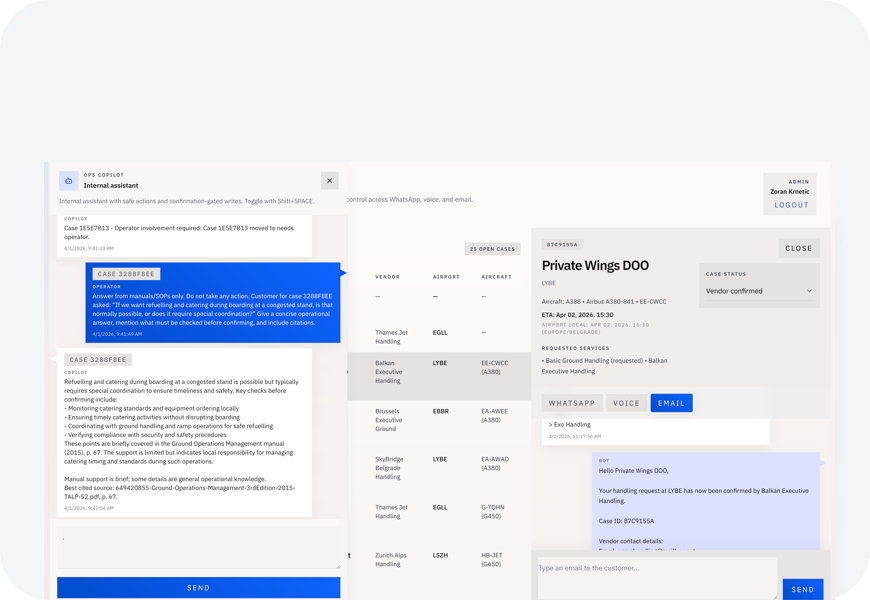
Customer requests arrive over WhatsApp, voice calls, and email. The system reads them, extracts the relevant details, and creates a structured case record automatically. Your dispatchers see one case with full context, regardless of how the request came in.
No portal adoption required from your customers. They keep using the channels they already use.
Each case holds customer communication, operational details, vendor status, and copilot activity in a shared workspace. No switching between inboxes and tools to understand what is happening.
Case records persist across shifts, handovers, and follow-ups. When the night shift picks up, they see exactly what happened — without asking anyone.
The system manages vendor confirmation workflows — reaching out to handlers, tracking responses, and triggering fallback logic when a vendor does not confirm in time.
This replaces the manual cycle of emails, follow-up calls, and spreadsheet tracking that dispatchers run today.
The Ops Copilot is an internal assistant that answers from your operational manuals and SOPs — not from generic internet knowledge. When a dispatcher asks “what's the handling procedure for oversized aircraft at LSGG?”, the system pulls the relevant material and returns an answer with the source cited.
It is case-aware: it combines your procedures with live case data to answer practical questions in context. And it monitors workflow events — flagging when something needs attention, proposing next steps for your dispatcher to approve.
Every consequential action requires human approval. The system proposes. Your team decides.
Demo
The demo shows customer requests arriving across channels, cases being created and updated, vendor confirmations and fallback logic, live voice updates, and the Ops Copilot handling case questions and improvement proposals.
Getting started
The video above shows the system handling a real dispatch scenario end to end. If the patterns look familiar, you are in the right place.
You will see the system live, ask any questions, and hear an honest assessment of whether it fits your operation. You walk away knowing exactly whether AI-native ops is viable for your team — and what it would take to get there. Nothing to buy on the call.
We map what transfers directly from Exo and what needs to be built for your specific workflow. You get a clear picture of what the system would look like for your team, and what it would take to get there.
Built by
Happy Path Solutions leads product, design, and AI architecture. Happy Path designed and built the Exo Handling system.
Kombinat is a 22-person engineering firm that leads delivery. Kombinat has built operational systems in the aviation fuel and handling segment for years. Exo Handling is where that operational depth meets AI.
“Their eye for detail and willingness to understand the requirements thoroughly before designing and developing our platform were key reasons for the successful launch of our product. They were keen not just to develop the platform but to be part of our business and take on a first-person view of what we wanted to create.”
Pablo Fexer
CEO, 360 Jet Fuel
“I always felt that they truly listened to our needs and found thoughtful ways to address them. From early product shaping to detailed QA, they were proactive, responsive, and a pleasure to work with.”
Sonja Whitticase
Marketing Manager, Q8 Aviation
Book a free discovery call. You will see the system live, get an honest assessment, and walk away with a clear picture — whether you move forward or not.
Book a discovery call